

Perspectives


How much does it really cost to keep Maryland moving? The state’s six-year transportation capital budget, also known as the Consolidated Transportation Plan (CTP), provides a price tag on anticipated transportation improvements. The CTP establishes funding priorities for everything from highways and bridges to airports, ports, WMATA, commuter rail and public transit.
 |
 |
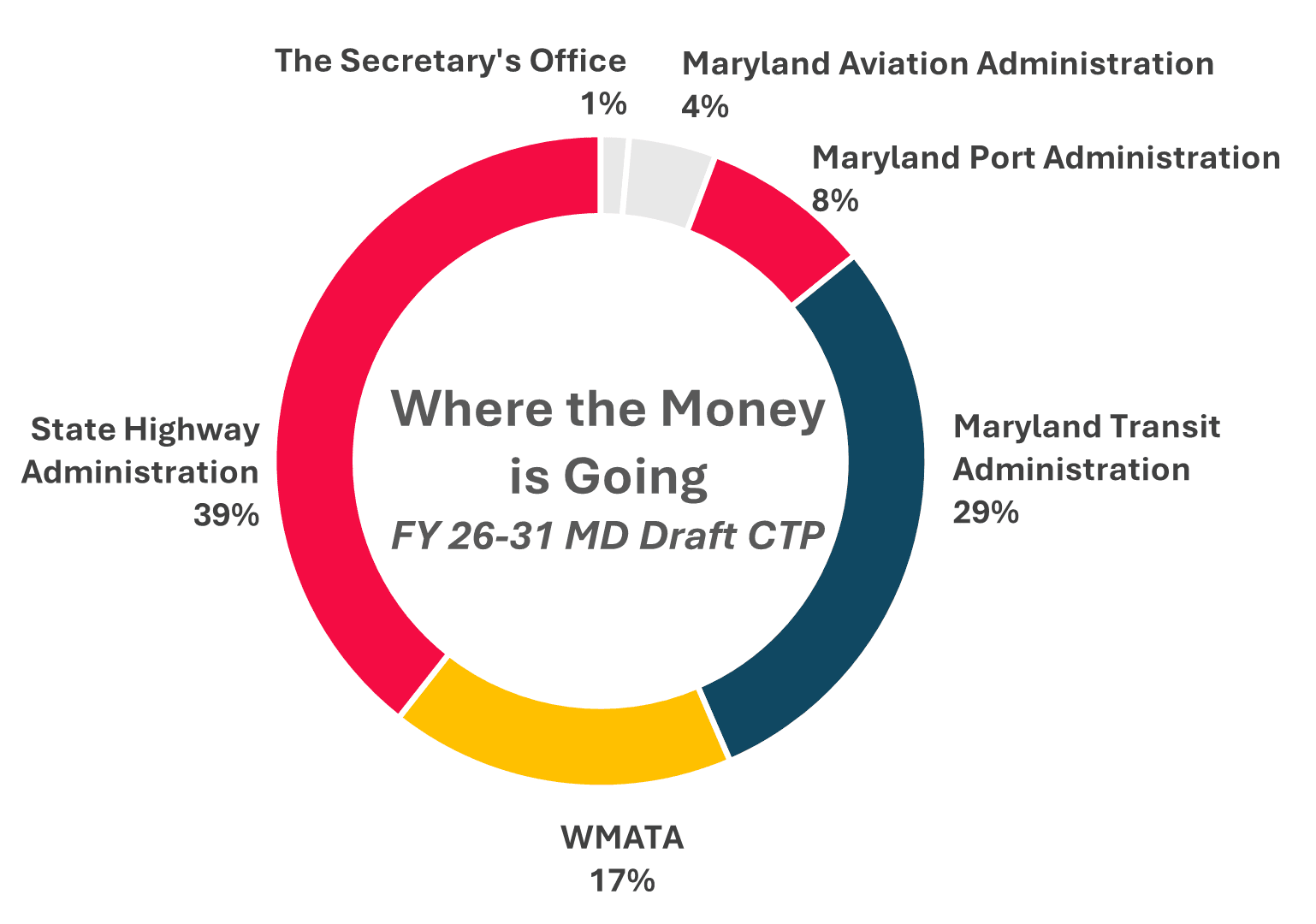
On September 2, the Maryland Department of Transportation (MDOT) released the draft FY 26–31 CTP, a comprehensive blueprint guiding $21.5 billion in transportation investments across the state. Although it will not be finalized until approved by the Maryland General Assembly in early 2026, the draft provides a comprehensive outlook on Maryland’s financial commitment and vision for its future transportation system.
The 525-page plan outlines where funding comes from and which transportation modes, projects and programs the funding supports. The CTP also provides a geographic breakdown of which communities will benefit from the proposed investments. Several questions remain unanswered—namely the evolving nature of the Key Bridge rebuild and financial uncertainty surrounding Baltimore’s Red Line. However, the plan outlines a path forward for several key priorities and improvements and signals a more optimistic outlook for the state, its residents and their multimodal access to opportunity than in recent years.
Diving Deeper: Maryland’s FY 2026-2031 Draft CTP
Throughout the plan, it is clear that Maryland’s transportation systems are guided by three key priorities:
- Improving the safety of Maryland’s transportation network
- Preserving Maryland’s transportation systems
- Driving economic growth across Maryland
Maryland needs increased investment to significantly advance these priorities. Last year’s CTP revealed a $1.3 billion funding gap over six years, which resulted in cuts across all MDOT modal administrations. The FY 26–31 Draft CTP, however, marks a shift by increasing funding over last year’s budget. This growth is largely due to Gov. Wes Moore’s leadership and an additional $400 million in revenue authorized during the most recent General Assembly session. This increase continues a trend of modest but consistent growth in transportation funding over the past five CTP cycles, as outlined below.
 What’s In:
- Upgrading MTA assets for better service – $1 billion for the Light Rail Modernization Program, which includes replacing the existing fleet with modern vehicles, upgrading all light rail stations and systems, and improving Metro SubwayLink reliability with new train cars and a modern communications-based train control system. As a result of these investments, MTA reports that this year’s CTP meets 90 percent of its state of good repair needs.
- Improving and expanding Maryland’s passenger rail network – More than $900 million for state-of-good repair and enhancements to MARC rail service, including fleet recapitalization, modernization of existing rail corridors and expansion of dedicated maintenance facilities to reduce interference with Amtrak operations at Washington Union and Baltimore Penn Stations. The FY26-31 draft CTP also includes $1.2 billion to complete construction and begin operations of the new light rail Purple Line in suburban Washington, D.C., which connects to Amtrak, MARC, and WMATA Metrorail trains.
- Improvements to regional airports – $27 million for Baltimore Washington International (BWI) Airport’s Passenger Movement Modernization Program, which includes replacing of bridges, elevators, escalators, and moving walkways and $23 million for the replacement of Martin State Airport’s air traffic control tower.
- Continued support for Metrorail – Continued distribution of $167 million in annual dedicated funds for WMATA’s system preservation and capital improvements and a sustained commitment to support transit-oriented development in North Bethesda and Capitol Heights, building on previous joint development successes.
- Advancing MDOT’s transit-oriented development (TOD) program – Launching the first round of state-supported TOD projects at Reisterstown Plaza in Baltimore, Odenton MARC station in Anne Arundel County and Bowie State MARC Station in Prince George’s County, while partnering with Baltimore City and Montgomery County to manage related local grants distributed from the TOD fund.
- Key MDOT safety improvement projects – More than $90 million for key vehicular and pedestrian safety improvements on corridors including I-81, MD 97 and MD 5, along with implementation of the highest-priority actions from the state’s Pedestrian Safety Action Plan.
What’s Out:
- Investments toward the Baltimore Red Line – Despite last year’s announcement by Gov. Moore confirming light rail as the preferred mode for the East-West Red Line, the draft CTP includes no construction funding for the project, meaning that no construction is planned within the next six years. Given the scale and cost of implementing light rail, this exclusion is significant. Baltimore’s Transit Future (BTF) coalition, a coalition co-led by the Partnership and the Greater Baltimore Committee, has outlined the substantial economic impact of the Red Line, but the path forward for the project remains unclear. Read more here.
- A clear path forward for the Key Bridge – The plan notes that the $1.8 billion Key Bridge rebuild is fully funded through federal sources and estimated for completion in 2028. However, uncertainties remain around the total project cost, with some estimates exceeding $5 billion, and growing discussions about the need for state funding. The draft CTP does not account for potential cost increases or a revised funding breakdown, leaving the Key Bridge poised to be a major topic in the upcoming General Assembly session.
- Implementation of the BMORE Bus Plan – MDOT MTA’s BMORE Bus Plan, released this summer, lays out a vision for an enhanced bus network in Baltimore. Estimated to cost $1.1 billion to implement, the plan would greatly improve bus frequency, reliability, and connectivity, improving mobility options for Baltimore residents. While the draft CTP celebrates the BMORE Bus plan, it does not include funding for its implementation. Executing this plan is essential to connecting workers to jobs, employers to talent, and students to school.
- MARC Growth and Transformation – While the FY26-31 draft CTP makes significant investments in the MARC system, most of the capital investments required for expanded service as outlined in the MARC Growth and Transformation Plan are not funded, including the additional fourth track at BWI, new stations at Bayview and Elkton, significant upgrades to the Camden and Brunswick line corridors, and investments to support connections to SEPTA in Delaware and VRE in Virginia.
FY28’s Looming Funding Cliff
While not an immediate concern for this year, the draft CTP presents a sobering outlook for Highway User Revenues (HUR) – the funds allocated to local jurisdictions responsible for maintaining more than 80 percent of Maryland’s road miles. According to the draft CTP, HUR funding is projected to decline by nearly $110 million in FY28. These funds are critical for local governments to support activities such as resurfacing, bridge repairs and safety improvements. The impact will be especially significant in Baltimore City, where the vast majority of roads are locally maintained. A reduction of this magnitude threatens to degrade road conditions, which in turn can hinder access to opportunity, disrupt bus operations and performance and compromise overall roadway safety.
Community Input
Each year following the release of the draft CTP in September, MDOT officials visit each Maryland county and Baltimore City to present the department’s draft budget and hear input from local officials, legislators, and stakeholders. This process, commonly known as the CTP Tour, kicked off in September and was recently wrapped up in early November.
This September, Baltimore City officials, legislators, and advocates gathered at Baltimore City Hall for Baltimore City’s CTP Tour meeting. The well-attended event featured testimony from many in attendance, including Baltimore’s Transit Future coalition. Echoing the priorities and concerns of others who testified, we applauded MDOT for the stability of this year’s CTP compared to previous years but called for increased investments in transit expansion projects – like the BMORE Bus Plan and the Red Line – which are not funded in this year’s CTP.
Next Steps and Opportunity for Engagement
At the start of the Maryland legislative session, which runs from January 14 through April 13, MDOT will publish the final CTP for public review. The MDOT secretary will present the final CTP in budget hearings to the General Assembly, where members of the public can provide written or oral testimony. The legislature will then vote to adopt the final CTP, determining how billions in state transportation investments will be allocated over the coming years.

For Greater Washington Partnership and its partners across the regional business community, this process represents a critical opportunity to advocate for investments that strengthen regional connectivity, support economic competitiveness, and advance shared priorities in transit, infrastructure and inclusive growth. Ensuring that the final CTP reflects the needs of the broader region will be key to fostering long-term economic vitality and equitable access to opportunity.