
The region is entering a period of significant rail upgrades. From a new tunnel beneath Baltimore and a second passenger rail crossing over the Potomac to station and service-support investments in Richmond, projects now underway or being planned will replace aging infrastructure, relieve longstanding bottlenecks, and create room for more frequent and reliable service across the corridor.
Together, these projects advance priorities championed by the Partnership by removing critical bottlenecks and creating a more connected and reliable regional rail network. Delivering them will expand access to jobs and talent, strengthen connections between Baltimore, Washington, and Richmond, and help the region compete for talent, business investment, and economic growth.
What the business community needs from regional rail
Earlier this month, together with the Northeast Corridor Commission and the Greater Baltimore Committee, we convened business leaders and public-sector officials from across the corridor to discuss how rail service affects employers, commuters, and the regional economy.
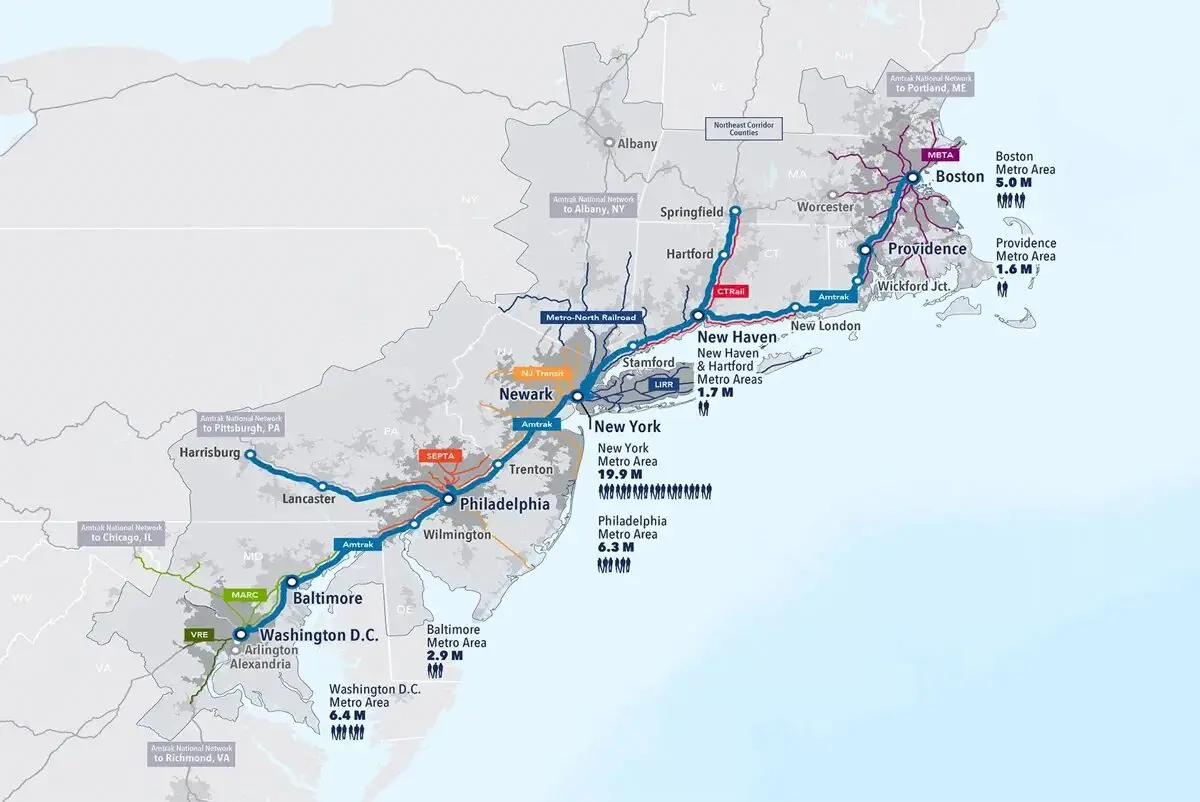 |
The Northeast Corridor. Source: Arup
The Northeast Corridor, the busiest passenger railroad corridor in the United States, stretches over 450 miles from Boston to Washington, D.C. The corridor’s supports a significant amount of economic activity in our region and throughout the corridor. According to the Northeast Corridor Commission’s FY2025 annual report, nearly 700,000 passengers use the Northeast Corridor each weekday. The corridor connects a $5.9 trillion economy, and an unplanned one-day shutdown would cost more than $170 million in economic activity.
Demand is also growing: In FY 25, Amtrak reported more than 12 million Northeast Regional trips , up 11.3% from FY 24. Virginia’s four state-supported Amtrak routes also set a new ridership record, carrying 1.45 million passengers in state FY2025, up 4.8% from the previous year, with increases across all four corridors. Richmond’s Staples Mill Road Station remains the busiest Amtrak station in the Southeast, serving more than 500,000 passengers in federal FY2025.
The conversation, which will be used to inform the Commission’s forthcoming economic impact report, reinforced three rail priorities for businesses:
- Reliability matters. Employers and employees make decisions based on whether service is dependable, not simply whether a rail line exists. Reliable intercity and commuter rail can expand the geography of opportunity.
- Good rail service is physically and digitally connected. Dense and walkable development around rail stations, safe and convenient first- and last-mile connection options, and reliable cell service all shape whether travelers can use rail efficiently. Investments in tracks and stations should therefore advance alongside improvements to the full passenger journey.
- Major rail projects require predictable funding and durable partnerships. The corridor crosses state lines, railroad ownership boundaries, and political cycles. Keeping projects on schedule will require sustained coordination among federal, state and local governments, rail operators, infrastructure owners, and the business community.
These themes align closely with the Partnership’s Capital Region Rail Vision and Blueprint for Regional Mobility 5-Year Refresh, which position rail as essential economic infrastructure. Both call for a more reliable, connected and easy-to-use network that expands access to jobs and housing, gives employers access to a broader talent pool and strengthens connections between Baltimore, Washington and Richmond. Achieving that vision will require removing physical bottlenecks while improving coordination among rail operators so that infrastructure investments translate into better service and a more competitive regional economy.
A connected corridor under construction
From Baltimore to Richmond, a continuous chain of investments is beginning to address the corridor’s most consequential capacity constraints. Each project solves a local problem, but its benefits extend across the broader network because a delay or bottleneck in one location can affect service across the corridor.
Maryland
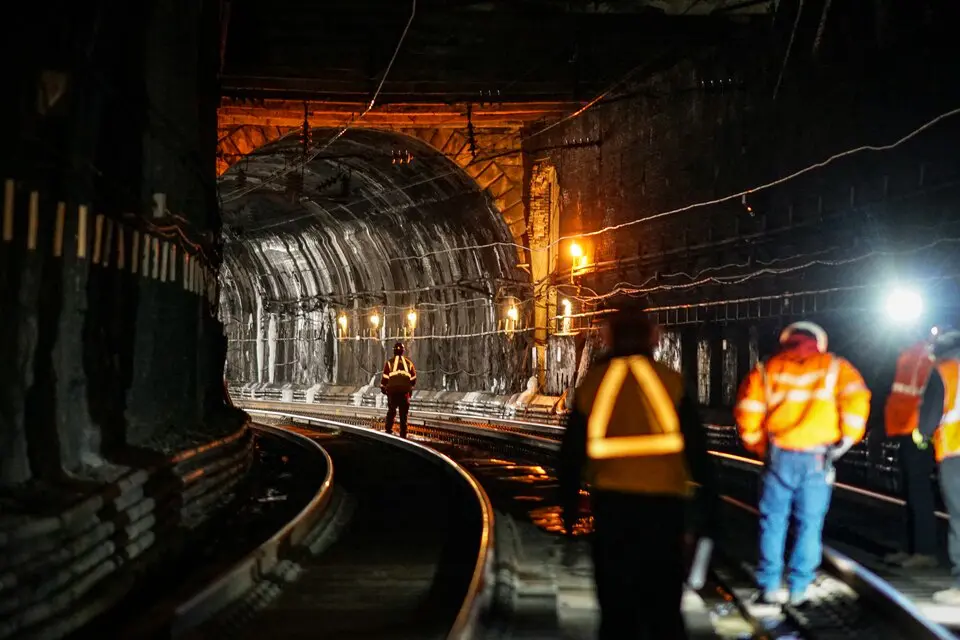 |
Existing B&P Tunnel. Source: Daniel Zawodny/The Baltimore Banner
In Baltimore, Amtrak is undertaking its largest-ever single infrastructure investment: the B&P Tunnel Replacement Program. The project will replace the 153-year-old Baltimore and Potomac Tunnel, the oldest tunnel on Amtrak’s network and a single point of constraint for roughly 15 million annual Amtrak and MARC riders. Opened in 1873, the 1.4 mile tunnel is constrained by tight curves that limit trains to 30 mph, while deteriorating conditions due to its age contribute to recurring maintenance needs and delays.
Construction is advancing on utility relocations, bridge work and preparations for the two tunnel boring machines. As of July 2026, the first machine was more than halfway complete, with launch planned for 2028. The full program, targeted for completion in 2036, includes two new passenger-rail tunnel tubes, a fully accessible West Baltimore MARC station, and approximately 10 miles of related rail improvements. It will remove the most congested rail bottleneck south of New Jersey and improve reliability for trains moving throughout the corridor.
Just to the north, improvements at Baltimore Penn Station are increasing capacity and operational flexibility at the region’s northern rail gateway. Amtrak’s investments include two new high-level platforms, elevators and other accessibility improvements, as well as restoration of historic station elements. The first new platform entered service in 2024, with additional platform and station work continuing.
Meanwhile, the broader redevelopment of Penn Station is being reevaluated: in June 2026, Amtrak and Penn Station Partners announced they were restructuring their partnership and would separately pursue elements of the previously planned station expansion and surrounding development, which had included a new station building north of the tracks. Together with the B&P Tunnel Replacement Program, the rail infrastructure improvements underway at Penn Station will support more reliable service and help accommodate future Amtrak and MARC demand.
Washington, DC
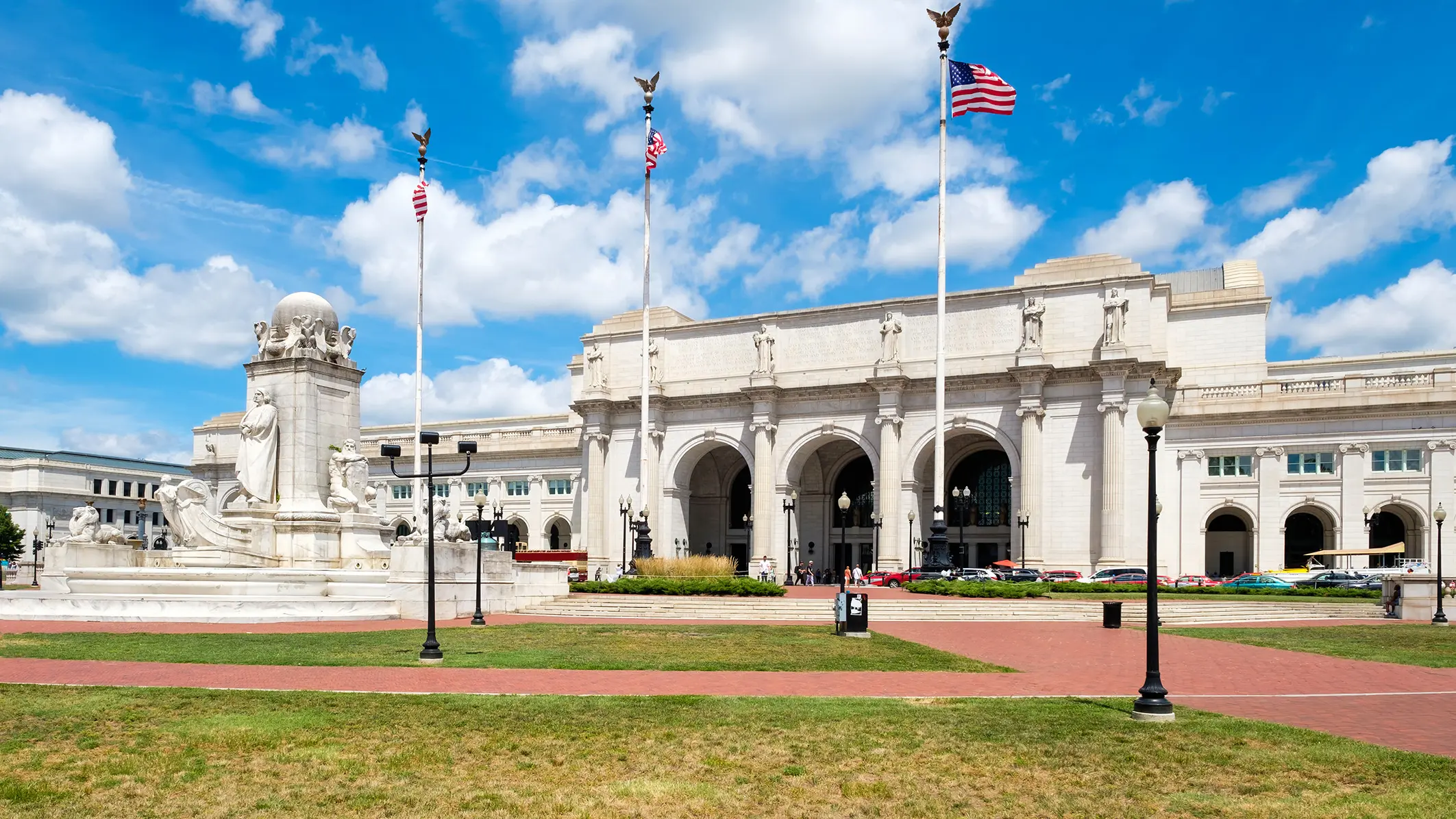 |
Washington Union Station. Source: Amtrak
At the center of the regional rail network and the southern terminus of the Northeast Corridor, Washington Union Station must accommodate Amtrak, MARC, VRE, Metrorail, intercity and local buses, and millions of travelers each year. The station is already operating beyond capacity during peak periods, with crowded passenger areas, constrained circulation and aging infrastructure limiting its ability to accommodate additional service. Its current track configuration also limits opportunities to better connect MARC and VRE service across Washington and expand rail connections between Maryland, the District, and Virginia. Because nearly every passenger rail trip between the Northeast Corridor and Virginia passes through Union Station, these constraints affect the broader regional rail network.
Near-term investments are beginning to address some of those needs. In May 2026, the U.S. Department of Transportation announced $466 million for improvements, including critical structural repairs, passenger-concourse improvements, security upgrades and enhancements to ticketing and customer facilities. An additional $24 million announced in July will support development of a public-private partnership and a new approach to expanding the station’s capacity.
The path for the station’s larger redevelopment, however, is less certain. In 2024, FRA put out a long-term expansion plan that envisioned new and reconstructed tracks and platforms, expanded passenger facilities and improved connections to surrounding neighborhoods and development. In July 2026, USDOT announced that it was setting aside that approach and would instead work with Amtrak, the Union Station Redevelopment Corporation and private-sector partners to develop a revised and more readily fundable expansion plan. The scale, design, cost and timeline of that long-term redevelopment have therefore yet to be determined.
South of Union Station, the VRE L’Enfant Station and Fourth Track Improvements Project will address a key bottleneck in the rail corridor between Washington and Virginia. This stretch of track operates near capacity during rush hour, while the existing L’Enfant Station has limited platform capacity that constrains train movements and contributes to congestion and reliability challenges.
The project will expand one of VRE’s busiest stations with a new center platform capable of serving two full-length trains simultaneously, allowing trains traveling in either direction to board passengers at the same time. New stairs and elevators at both Sixth and Seventh streets SW will also provide more direct access to the surrounding neighborhood and additional circulation and waiting space for passengers. Just as importantly, the project will add a continuous fourth track between Fourth and Twelfth streets SW, eliminating a gap in the four-track corridor being created between the new Long Bridge and Washington Union Station.
Virginia
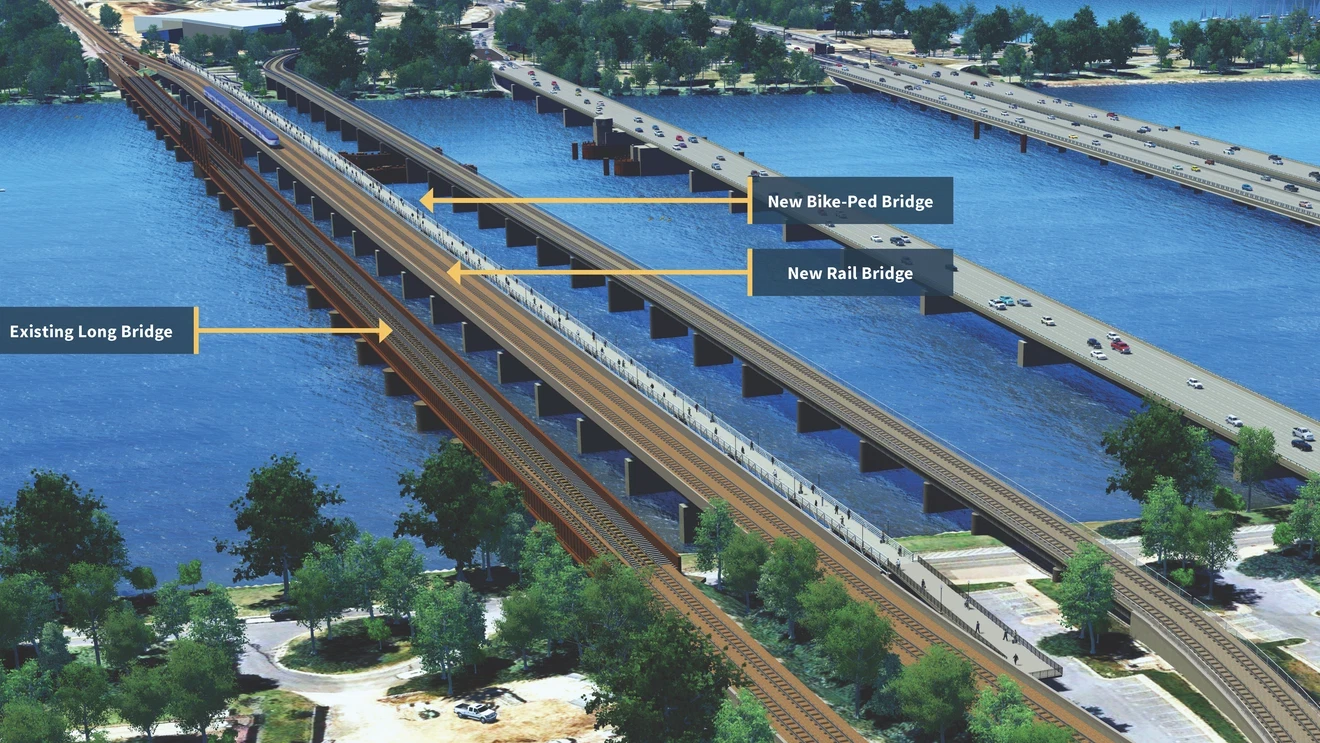 |
Rendering of the existing and new bridges being constructed as part of the Long Bridge Project. Source: Virginia Passenger Rail Authority
The Long Bridge Project is the centerpiece of Virginia’s passenger rail expansion program and will address one of the most significant rail bottlenecks on the East Coast. Today, the century-old, two-track bridge over the Potomac carries Amtrak, VRE and CSX freight trains and operates at roughly 98% of capacity during peak periods, leaving little room to add service and creating conflicts between passenger and freight movements that can contribute to delays.
The project will construct a new two-track passenger rail bridge alongside the existing CSX-owned bridge, effectively doubling rail capacity across the Potomac and allowing passenger and freight trains to operate separately. It is part of a larger 1.8-mile program that will create a continuous four-track corridor from Arlington to L’Enfant Plaza, including five new rail bridges and a new bicycle and pedestrian crossing of the Potomac. Combined with the L’Enfant Station and Fourth Track improvements to the north, Long Bridge will remove a major choke point between Virginia and Washington and create the infrastructure needed for more frequent regional and intercity rail service. The project is currently under construction and targeted for completion in 2030.
That new capacity must continue south through Northern Virginia. Improvements at Crystal City Station are moving toward construction and are being coordinated with the new fourth track, creating a longer and more accessible station designed for future service growth.
Farther south, the Alexandria Fourth Track will add six miles of track between the southern end of the Long Bridge corridor and Alexandria’s Amtrak Station, relieving the point where the VRE Fredericksburg and Manassas lines converge. At Alexandria Station, reconstructed platforms, new elevators and a replacement pedestrian tunnel will improve accessibility and eliminate the existing at-grade track crossing. The adjacent King Street and Commonwealth Avenue rail bridges will also be replaced, reducing maintenance needs and creating safer space beneath the tracks for people walking, biking and driving.
Lastly, the Franconia-Springfield Bypass will address another passenger-freight conflict farther south. Its bridge will carry passenger trains over freight tracks, increasing capacity and improving reliability for both services. Together, these investments are central to the Transforming Rail in Virginia initiative, which is expected to support an increase in state-supported Amtrak Virginia service from eight to 13 daily roundtrips and expand VRE service, including new weekend options.
In Richmond, additional investments are preparing the region for expanded passenger rail service. VPRA is advancing a new Richmond Layover Facility near Main Street Station to reduce rail congestion and support additional Amtrak service, while improvements at Staples Mill Station are moving through design. Virginia is also advancing preliminary engineering for the Richmond-to-Raleigh S-Line, which would strengthen Richmond’s connection to a growing passenger rail network along the East Coast. Additionally, the introduction of Airo trains beginning in 2026 will allow trains travelling from Richmond to Baltimore to seamlessly transition between electrified and non-electrified tracks without needing a time-consuming locomotive change at Union Station.
Keeping the corridor on track
Taken together, these projects represent more than a collection of individual infrastructure upgrades. Across the region, physical constraints that have limited rail service for decades are being removed, creating the capacity for a more reliable, frequent and connected regional network. But new tunnels, bridges, tracks and platforms are only part of the equation. Complementary, and often more affordable, investments in transit-oriented development, walkability, and first- and last-mile connections can make stations easier to reach, improve the rider experience and generate additional ridership. Delivering the full economic value of the region’s rail investments will also require sustained funding, coordination across operators and jurisdictions, and a continued focus on how passengers experience the network from door to door.
The business community has an important role to play in that effort. Employers can reinforce demand for rail through commuting and travel programs, locate jobs and investment near stations, and support transit-oriented development that makes rail more useful to workers and customers. Business leaders can also help make the case for predictable infrastructure funding and policies that keep major projects moving across political and jurisdictional boundaries.