

Perspectives


From Baltimore to Richmond, the Greater Washington region boasts among the strongest concentrations of research and development (R&D) in the country. Yet that research advantage has not led to the same level of commercial startups, scale-ups, and spinoffs that propel economic growth elsewhere in the U.S. Improving the latter stages of the innovation pipeline is crucial for the region’s competitiveness — leading to greater commercialization, more regional startups, and expanded high-growth sectors.
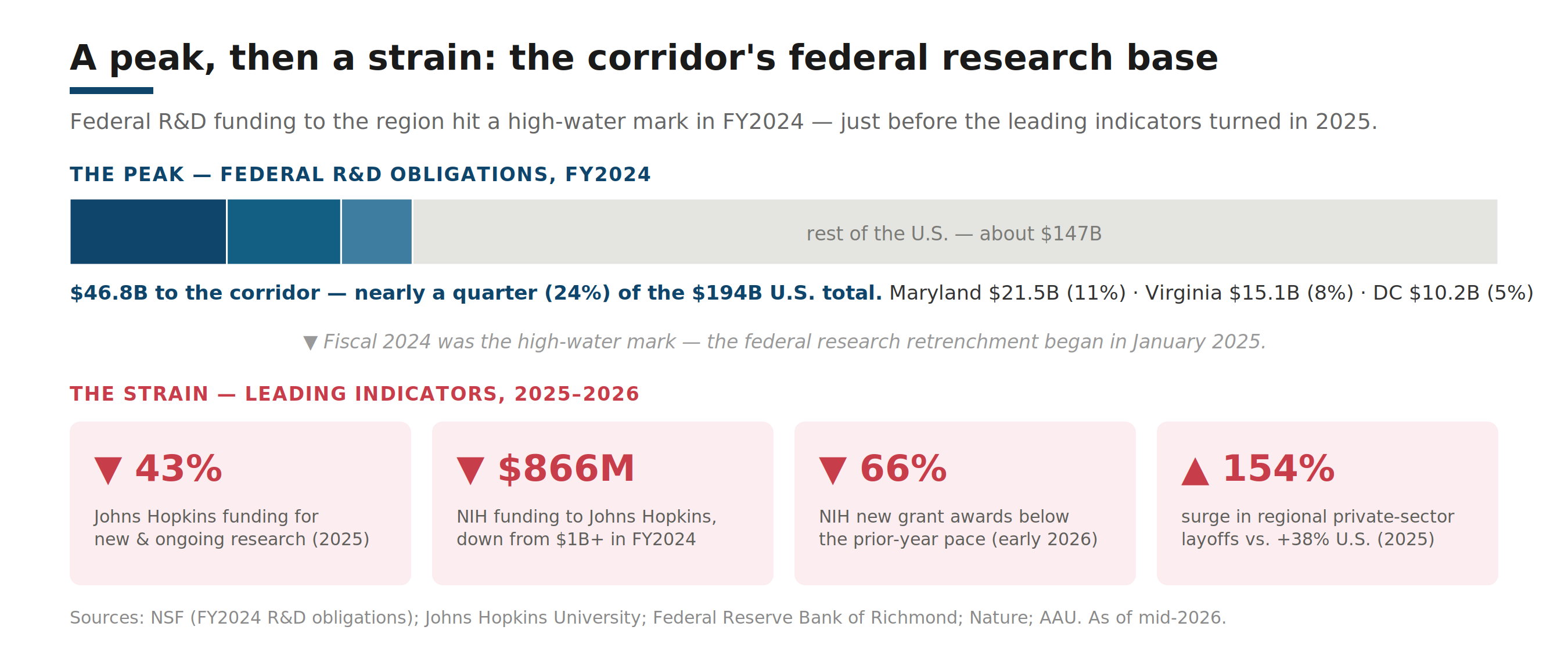
What’s clear is that the region’s early-stage advantage in research is nearly unmatched. In fiscal year 2024, just under a quarter of the federal government’s $194 billion in R&D obligations were destined to the region. Complementing that strength is the region’s strong production of graduates with science and engineering degrees and large share of coveted federal SBIR/STTR grants that help the region’s research-heavy startups commercialize technology in their early-stages, especially in life sciences and defense tech.
But that strength – driven by reliance on the federal government – has recently become a pressure point. Since 2025, the region’s research base has faced considerable cutbacks: Johns Hopkins, the nation’s top recipient of federal research funding, reported a 43% drop in funding for new and ongoing research and a decrease of more than $500 million to its research portfolio – critical funding that supported 19,000 jobs and contributed $4.7 billion to the state’s economic output. More broadly across the region, grant terminations and contract cuts drove a 154% surge in private-sector layoffs — driven largely by cuts hitting universities, think tanks, and government contractors.
 |
Even without the pressure of those recent challenges, the conversion of research to commercial development and private sector growth was already a weak point. The region’s rate of creating new entrepreneurs and startup jobs has tended to fall in the bottom half of states in recent years, while venture capital (VC) funding is middling relative to many peers. Consider one stark comparison: in 2025, VC flowing into Massachusetts biopharma companies alone ($6.8 billion) outpaced all the VC funding raised across the region in every sector combined ($6.3 billion).
As identified in the Greater Washington Partnership’s Region Rising strategy to guide future economic diversification and growth, closing the gap from research to commercialization and scale-up is as a key cross-cutting enabler to boost outcomes and become more economically competitive.
A breakdown in the innovation funnel: world-class research inputs, middling commercialization, and bottom-tier entrepreneurial outcomes
Compared to other states, the region’s metrics tell one consistent story: performance tends to rank relatively low on outcomes related to commercialization and entrepreneurship despite leading on R&D.
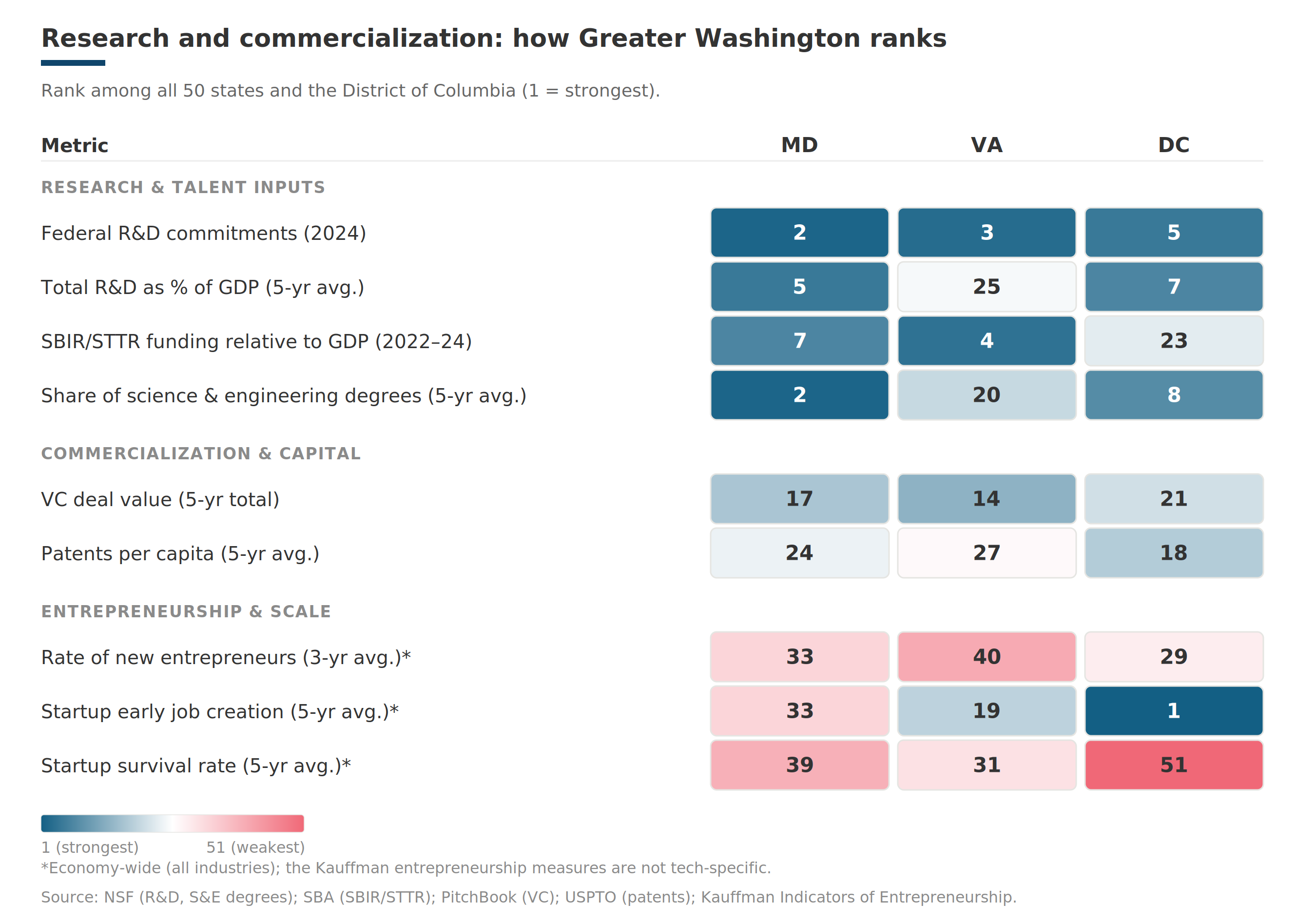 |
By almost any measure of research dollars and technical talent, the region is in the top tier: Maryland ranks 2nd in federal R&D commitments, 5th in total R&D as a share of GDP, and 2nd in the share of science and engineering degrees awarded. Virginia and DC sit close behind on federal R&D (3rd and 5th), while Virginia ranks 4th in SBIR and STTR funding relative to GDP.
The picture starts to dim at the commercialization step. VC deal value falls to the middle of the pack (Virginia 14th, Maryland 17th, DC 21st), and patents awarded per capita land lower still (DC 18th, Maryland 24th, Virginia 27th) — clear evidence that the region’s research isn’t converting into private sector growth at the rate its early-stage investments might suggest.
By the time the innovation funnel reaches new-company formation, the region sits near the bottom. All three jurisdictions fall in the lower half on the rate of new entrepreneurs (DC 29th, Maryland 33rd, Virginia 40th), and the startup measures are weaker still. Maryland, despite its top-tier research base, ranks 33rd in startup early job creation and 39th in survival, while Virginia sits 19th and 31st. A notable exception is DC, which ranks 1st in the nation in startup early job creation yet dead last (51st) in startup survival, suggesting it is a place that spins up new firms quite successfully but struggles to keep them alive.
What regional business leaders are seeing
Business and civic leaders acknowledge the commercialization challenges and point to the region’s lack of a coordinated system to scale companies and its deep reliance on federal dollars, which has recently become its most acute vulnerability. Those pressures have become starker with federal cutbacks in the region, including a six-month shutdown and ongoing slowdown in Small Business Innovation Research (SBIR) funding – also known as “America’s Seed Fund”, which is a highly competitive federal initiative that encourages domestic small businesses with strong potential for commercialization to engage in federal R&D.
According to industry leaders, that disruption has opened an estimated 18-month gap in the early-stage capital that Maryland life-science companies depend on. These federal approval delays and research-funding reductions are straining university and industry capacity, in some cases forcing layoffs of research teams, and turning a strength into a liability.
However, leaders also see clear opportunities to address these issues, pointing to state tools that can bridge the SBIR gap and a need for improved regional collaboration to fully leverage existing advantages. They also see the benefits of scaling proven cluster strategies built on assets like the BioHealth Capital Region and quantum-computing anchor IonQ located in the Discovery District at the University of Maryland that can help concentrate and drive industry ecosystem growth.
Washington, DC, has also leaned into its strength as a place to connect the various stages of innovation – from ideation to production and customer connection – through efforts such as Startup and Tech Week, which highlights local entrepreneurship and the latest advancements in tech, hoping to foster a more inclusive and comprehensive ecosystem for innovation and growth.
These nascent efforts are important steps in the right direction, especially for key regional industries that are primed for growth, like quantum and defense technology, that will require better capital funding and alignment on unique real estate development needs not present in the existing market.
Maryland’s DECADE Act: a step in the right direction
Policymakers have taken notice, as well, and Maryland recently passed the 2026 DECADE Act, which extends the state’s R&D tax credit with refundable credits that let pre-revenue startups turn research into cash and broadens the RISE Zone program, an initiative built explicitly to commercialize technology from universities and federal labs. The new law also extends Build Our Future innovation grants that support innovation infrastructure projects tied to high-growth industries, restructures the state’s deal-closing funds for faster, more flexible response to competitive opportunities, and extends job-creation and security-clearance tax credits that benefit biotechnology, cybersecurity, and advanced manufacturing.
What works elsewhere, and what the region can borrow
As regional leaders work to improve outcomes in Greater Washington, peer regions that convert research into companies most effectively often combine multiple levels of support. A few of these strategies include:
Using public funds to attract capital and boost private-sector outcomes
State-backed organizations can help make early commercialization efforts less risky, spurring private investment that otherwise might not occur. North Carolina’s Biotechnology Center (NCBiotech) is one of the most successful efforts, helping make the Research Triangle area the success that it is today. Operating as a publicly funded economic development organization, its efforts are hyper-focused on the life sciences sector and helps strengthen the research capacities of private companies to accelerate innovation, investment, and job creation.
While Maryland’s TEDCO and Virginia’s Innovation Partnership Corporation (VIPC) are similar commercialization engines, they were established more recently and tend to spread their investments across the region’s many strengths, from cyber to quantum to life sciences. A potential lesson from North Carolina’s success is that focusing instead on a sustained, decades-long bet on a signature sector could be a more effective model for turning a deep research base into lasting commercial density.
Building shared, public-private innovation spaces
North Carolina’s Research Triangle Park and Boston’s Kendall Square are the prime examples of public-private coordination for a reason, setting the benchmark for deliberately built dense, mixed-use innovation districts that physically co-locate universities, startups, and established companies all in one place.
Notably, the region is also starting down this path: Virginia Tech’s $1 billion Innovation Campus opened in Northern Virginia in 2025 and co-locates graduate talent, industry partners (including Northrop Grumman), and government around AI, quantum, and other tech sectors primed to grow in the region.
Growing local capital, not just relying on investors from elsewhere
Austin’s Capital Factory has quickly become a hub for startups — combining an accelerator, coworking hub, and investor network to support company growth. The city’s efforts have benefitted from a lower-cost, lighter-regulation business climate and a pandemic-era wave of talent and capital attraction, but the unified approach to capital attraction has led to rapid gains in solidifying its place as an epicenter of VC activity.
While there have been similar regional efforts (such as 1776 Ventures and Revolution), growing a local capital base remains among the region’s weakest links in the innovation funnel. In a positive sign about the region’s future prospects, though, Capital Factory in 2024 partnered with the District to launch Station DC, a tech and innovation hub offering mentorship, connections, and a collaborative space with a focus on dual-use innovation for tech with both commercial and government applications.
Maryland’s Capital of Quantum partnership also has the potential to eat into the region’s capital deficit. This strategic partnership between the state, the University of Maryland, and private and federal partners will drive more than $1 billion in investments through a combination of state funds, matching federal grants, private sector investments, and philanthropic contributions. Mirroring Austin’s success by building one durable, university-anchored hub could lead the region along the right path.
Commercialize for the region to rise
The region has spent decades powering the nation’s research efforts, but the opportunity now is to capture more of what that research creates — leading to more companies that start here, scale here, and stay here. That will only happen through regional collaboration that builds on current efforts to support purpose-built innovation districts, industry-specific infrastructure needs, deeper pools of early-stage and scale-up capital, and tighter alignment between the region’s universities and its employers. With federal research funding increasingly uncertain, the case for building a self-sustaining commercialization engine is now more important than ever.
Sources: NSF National Center for Science and Engineering Statistics, Survey of Federal Funds for R&D (FY2024) and HERD Survey; SSTI; PitchBook-NVCA Venture Monitor (2025–Q1 2026); Johns Hopkins Technology Ventures FY25 Annual Report and JHU FY2024 Economic Impact Report; MassBio; Maryland DECADE Act (SB 388 / HB 898, 2026).