
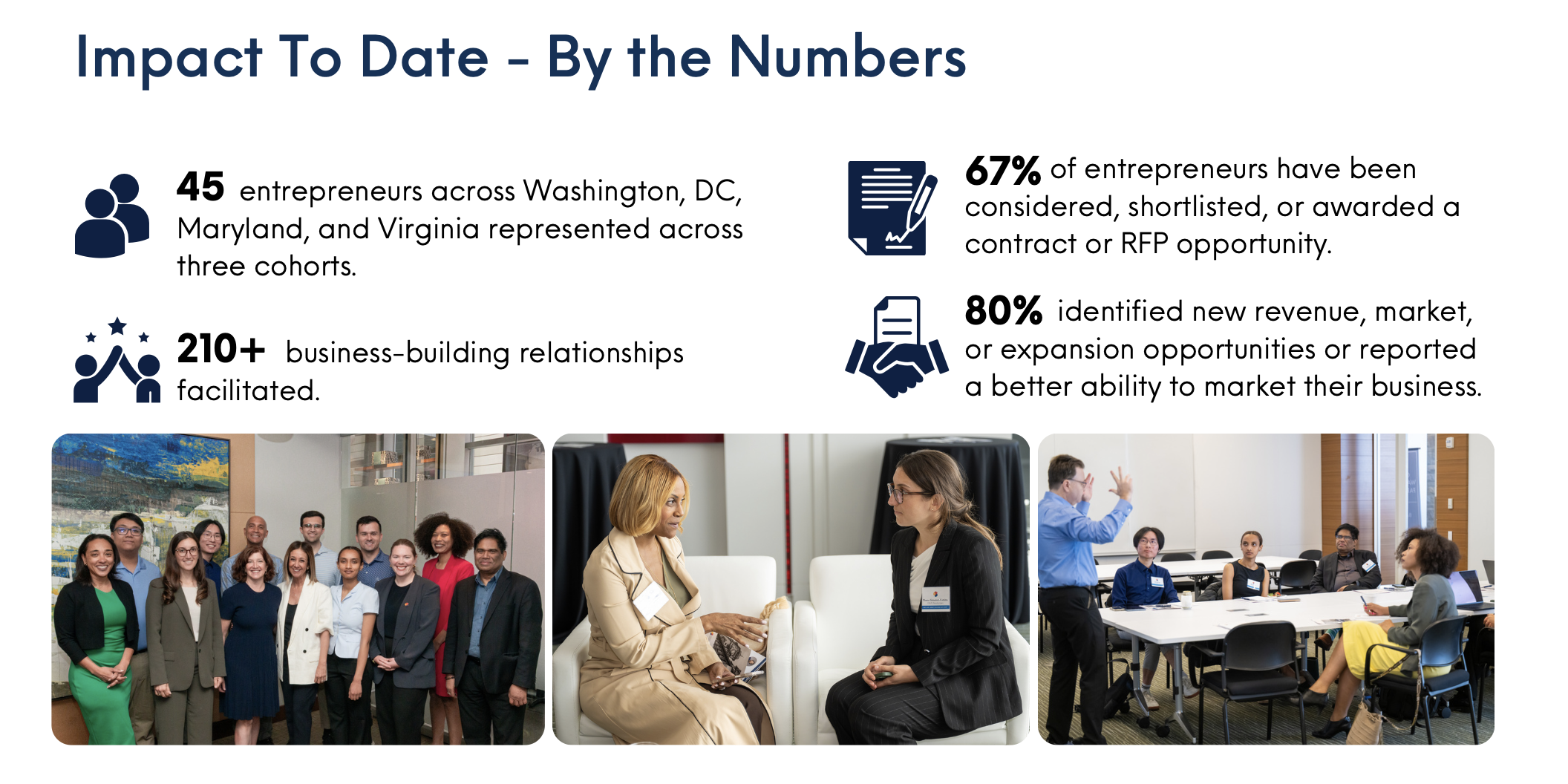
Greater Washington has the ingredients of a leading innovation economy. The challenge is converting more of that innovation into companies that start, scale, and stay here. Next Level: Growth Exchange is one way the Partnership is helping put that vision into practice. Now in its third cohort, the program has supported 45 entrepreneurs from across Washington, DC, Maryland, and Virginia since its launch in 2023.
The need for programs like Next Level reflects a broader regional opportunity. Greater Washington has long been one of the nation’s leading centers for research, technical talent, and innovation. From Baltimore to Richmond, the region is home to world-class universities, federal laboratories, major employers, and entrepreneurs developing solutions to some of the most consequential challenges facing our country.
Yet, as recently explored in our analysis of the region’s commercialization gap, “The Region Leads in R&D but Lags in Entrepreneurship and Commercialization,” Greater Washington has not consistently translated those advantages into enough successful startups, scale-ups, and commercial businesses that our significant assets and resources would suggest.
Closing that gap is critical to the region’s long-term competitiveness. It is also a central priority of Region Rising, the Partnership’s roadmap for economic diversification and growth. Region Rising organizes the region’s priority industries into two categories: foundational sectors that form the bedrock of Greater Washington’s economy, and high-growth sectors, including technology, life sciences, aerospace and defense, and advanced manufacturing, that have significant potential to drive future growth. The strategy calls for the region to both defend and extend our foundational industries while deliberately growing our presence in these emerging sectors, where Greater Washington has distinctive assets and opportunities to capture more investment, innovation, and job creation. Next Level was intentionally designed to support that second goal by helping promising early-stage companies in these high-growth industries build the relationships and capabilities they need to scale in the region.
Launched in 2023, Next Level is the Greater Washington Partnership’s flagship accelerator for early-stage, high-growth companies across Washington, DC, Maryland, and Virginia.
The program leverages the strengths of the Partnership’s network of leading regional employers, connecting entrepreneurs with our board partner company executives, investors, procurement leaders, subject-matter experts, and other partners who understand what it takes to build, finance, commercialize, and scale a company. This year, leaders from our board partner companies including Virginia Tech, Ampcus Inc., Red Cell Partners, Akin, and Deloitte contributed their expertise and networks to support participating entrepreneurs. The program also benefited from the expertise of subject matter experts, investors, and innovators from Gula Tech Adventures, Revolution Ventures, and MaC Venture Capital.
Through masterclasses, strategic introductions, peer exchange, and networking opportunities, Next Level aims to create opportunities for participating founders to build relationships that can lead to new customers, capital, talent, and partnerships. All while strengthening the region’s innovation economy.
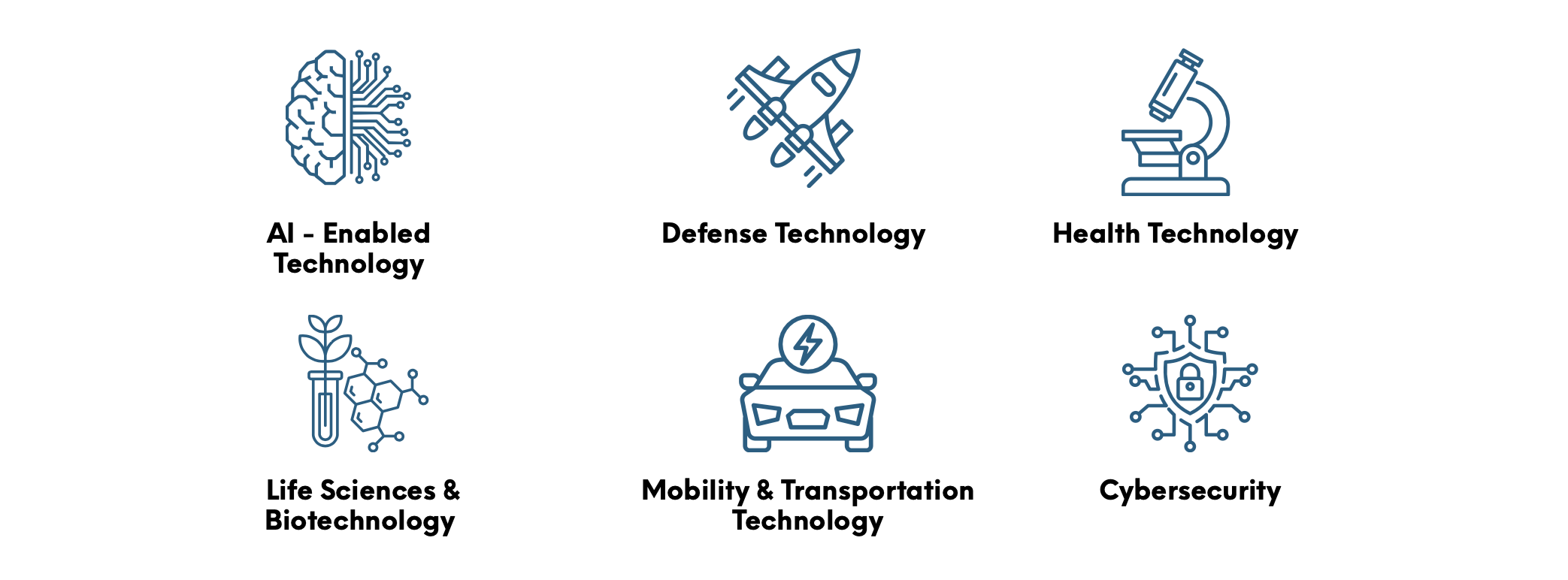
Seven entrepreneurs from across Washington, DC, Maryland, and Virginia completed the 2026 Next Level program. Together, these companies represent the breadth of innovation taking place across Greater Washington with solutions spanning AI & Cybersecurity (Good Gov AI, Hardshell, and Unitra), aerospace/defense & advanced manufacturing (Redhelm Labs), electric-vehicle infrastructure (Chargerzilla), and life sciences and health (Cureiosity and Orain Biotechnology). The cohort reflects the Region Rising vision of supporting companies operating in areas critical to the region’s economic future.
 |
The 2026 program was intentionally aligned to focus on our high-growth sectors, and the cohort companies in this phase of the program reflected several industries with significant potential to drive the region’s future growth:
 |
Over the course of the program, the founders participated in masterclasses led by experienced executives, investors, and regional innovation leaders. Sessions addressed the core challenges that early-stage companies face as they prepare to grow, including capital strategy, commercialization, supply chain and procurement, hiring and culture, legal considerations, artificial intelligence, and pitching your business.
But Next Level extends beyond the classroom. Founders also received curated introductions, peer exchange, and participated in networking opportunities with members of the region’s business and entrepreneurial ecosystem.
A highlight of the program was an intimate lunch with two venture-capital leaders that gave the cohort an opportunity to discuss their companies, receive direct feedback, and build relationships with individuals who understand the early-stage funding landscape. By helping founders navigate and access the region’s resources, Next Level works to strengthen the connective tissue of Greater Washington’s entrepreneurial ecosystem.
Participants reported tangible benefits from the 2026 program:
- 86% felt better prepared to pitch and showcase their businesses to investors, customers, partners, and other key audiences.
- 86% gained meaningful business insights and connections through the networking lunch with venture-capital leaders.
- 71% felt better prepared to identify and recruit talent that could help grow their businesses.
The 2026 program concluded with a graduation and pitch competition. Each founder presented their company to a panel of regional business leaders, demonstrating the progress they had made and using the skills they acquired to the test.
Andrew Shoka, founder of Hardshell, received the competition’s $25,000 pitch prize. The company is building a data-layer assurance engine for enterprise artificial intelligence platforms, helping organizations protect sensitive datasets before they enter AI and machine-learning systems. Founded in 2025, Hardshell has grown to six full-time and three part-time employees.
The results of the 2026 cohort build on Next Level’s growing impact across Greater Washington since the programs launched.
 |
These results demonstrate what becomes possible when the region’s established institutions intentionally open their expertise and networks to emerging companies. But programs like Next Level cannot address the region’s commercialization challenge alone. Building a more durable innovation economy will also require deeper pools of early-stage and scale-up capital, stronger connections among universities and employers, industry-specific infrastructure, and sustained public-private collaboration.
Greater Washington does not lack innovative ideas, groundbreaking research, or technical expertise. Our opportunity is to build a stronger bridge between those assets and successful commercial companies. We do this by working across jurisdictional boundaries and viewing the region’s entrepreneurial ecosystem as a shared economic asset.
The seven companies in the 2026 Next Level cohort represent the ingenuity already present across Greater Washington. By connecting founders with the region’s collective expertise, relationships, and resources, we can help transform that ingenuity into companies that solve consequential problems, create jobs, attract investment, and contribute to a stronger, more resilient, and competitive regional economy.